
How Does Hearing Loss Impact Outdoor Socializing and Family Gatherings?
Jubilee Day fills downtown Mechanicsburg every summer with food trucks,

By: admin | April 22, 2026
People are good at explaining away the things that feel off. Fatigue gets blamed on a bad night of sleep. Irritability gets chalked up to stress. Difficulty staying focused in a conversation gets attributed to distraction or just getting older.
These are all reasonable explanations, and sometimes they are the right ones. But hearing is a variable that almost never makes that list, even when it probably should.
It is one of the more quietly influential parts of how your body and brain function throughout the day, and most people have no idea how much it is shaping the way they feel until something else prompts them to look at it.
It is not about people being inattentive. Hearing does not change in a way that feels sudden or obvious. It fades little by little, your brain fills in the gaps and day-to-day life seems mostly the same, at least at first.
Listening is not a passive activity, even though it feels like it should be. Sound does not just arrive in your brain already sorted and labeled.
It goes through a whole sequence of steps before it becomes something you can actually make sense of, and each of those steps requires something from your body and your brain.
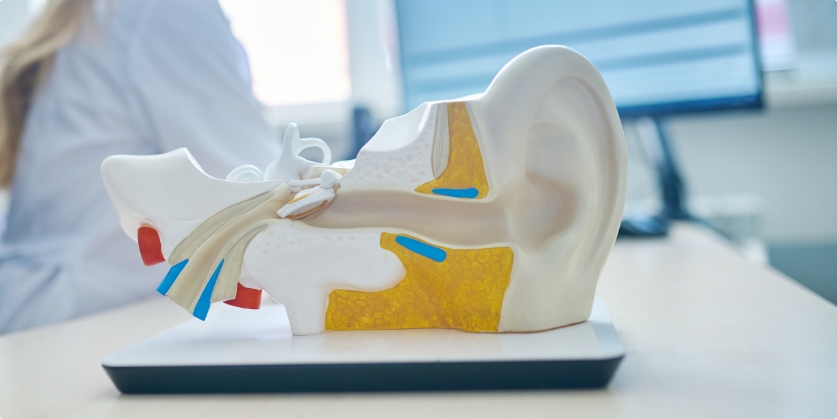
Here is what the hearing process actually involves:
You can still follow a conversation, but you are doing it the hard way, and that effort adds up over the course of a day in ways that are easy to misread as something else entirely.
People usually do not decide to pull back socially. It happens through a series of small, everyday adjustments that seem reasonable in the moment.
You choose the quieter corner of a restaurant because it is easier. You sit where there is less competing noise. You laugh at the right moments even when you did not quite catch the joke, because asking someone to repeat themselves a third time feels worse than just letting it go.
What gets lost in that process is the texture of conversation, the offhand comments, the quiet humor, the side exchanges that happen at the edges of a group.
Those are often the parts that make a gathering feel worth showing up to, and they are also the first things to go when hearing gets harder. When the effort it takes to participate starts to outweigh the enjoyment of being there, staying home begins to feel like the more reasonable option.
There is a reason people with untreated hearing loss sometimes feel like their focus is slipping. It is not that those things are failing. It is that most of their available mental energy is going somewhere else.
You are taking in fragments, filling in words, tracking context and guessing at meaning all at once and in real time. By the time you have worked out what someone said, the conversation has already moved on.
That leaves very little room for the brain to do what it is supposed to do with incoming information, which is process it, connect it to what you already know and hold onto it. Memory and comprehension depend on receiving a clear enough signal to work with in the first place.
When that signal improves, most people notice fairly quickly that they are following conversations more easily and retaining more of what was said. That is not a coincidence. It is just the brain doing its job with better material to work from.
Your ears are doing more than processing speech. They are constantly orienting you, tracking where sounds are coming from, how far away they are and how fast they are moving. That information feeds directly into your balance and your ability to move through a space with ease.
Much of that comes down to the vestibular system, housed in the inner ear, which most people have never thought about until something feels off:
The most telling sign of how hearing affects relationships is usually not a big moment. It is the small ones that quietly stop happening.
A partner who used to call something out from the next room starts just waiting until you are in the same space. A thought that would have been shared in passing gets dropped because the back-and-forth it requires does not feel worth it in the moment.
Nobody decides to communicate less. It just becomes the path of least resistance for everyone involved.
That shift matters because the casual, unplanned exchanges are often the ones that keep people feeling connected day to day. The quick check-ins, the observations about nothing in particular, the running commentary that long-term relationships are built on.
When those start to fade, conversations can become more transactional without anyone meaning for that to happen.
Your brain is constantly making decisions about what deserves your attention and what does not. In a noisy environment, it is supposed to push irrelevant sound to the background automatically so you can focus on the person in front of you without having to work at it.
Most people never notice that process because when it works well, it is invisible.
When hearing changes with the introduction of hearing loss symptoms, that filtering becomes less reliable. Instead of arriving in layers your brain can sort through, sound tends to arrive more uniformly, making it harder to separate what you want to hear from everything else around it.
You end up doing manually what your brain used to handle on its own, which means more concentration, more effort and a lot less mental bandwidth left over for actually engaging with the conversation.
That is why a noisy restaurant can feel genuinely exhausting in a way that a quieter one does not, and why the same person can feel like a completely different conversation partner depending on where you are when you talk to them.
The sounds most people stop noticing first are not the important ones. They are the small, ambient ones that were never demanding attention to begin with. The hum of a refrigerator. Rain against a window.
The specific way a familiar street sounds on a quiet morning. These are not sounds you were ever actively listening to, which is part of why their absence does not register as hearing loss right away.
What does register, eventually, is that the world starts to feel slightly less textured than it used to.
Environments that once felt full and familiar take on a flatness that is hard to name. It is not that anything dramatic is missing. It is the background detail that made a place feel like itself that has thinned out.
Hearing is part of how we stay connected to our surroundings in a way that goes well beyond conversation, and those quiet layers of sound are a bigger part of that than most people give them credit for until they are gone.
Hearing loss tends to get filed under communication problems, but what shows up alongside it tells a more complete story. The ears are not separate from the rest of the body, and what affects one often shows up in the other in ways that are easy to miss if nobody is looking for them.
Cardiovascular health is one piece of that. The inner ear depends heavily on consistent blood flow, and conditions like high blood pressure and heart disease affect circulation in ways that can quietly show up in your hearing before they show up anywhere else.
Diabetes works similarly. The small blood vessels and nerves that keep the inner ear functioning are vulnerable to the same damage that elevated blood sugar causes throughout the rest of the body.
If you are already managing a chronic physical condition, it is worth looping your audiologist into that conversation rather than treating your hearing as a separate issue entirely.
Hearing changes rarely announce themselves. They tend to show up in small, easy-to-explain-away moments that do not seem connected to each other until you step back and look at the bigger picture. If any of the following feel familiar, it is worth having a conversation with an audiologist:
Hearing is one of those things that is easy to put off because nothing ever feels urgent enough to act on. But the longer it goes unexamined, the more it quietly affects everything else. A hearing evaluation tends to answer a lot of questions people did not know they had.
If you are in the Mechanicsburg area and any of this has felt familiar, Duncan-Nulph Hearing Associates is a good place to start that conversation.
We work with people at every stage of hearing health and can help you figure out what is actually going on and what, if anything, makes sense to do about it. Give us a call at 717-610-6659 and we will take it from there.
Jubilee Day fills downtown Mechanicsburg every summer with food trucks,
By: admin | September 21, 2026
People are good at explaining away the things that feel off. Fatigue gets
By: admin | April 22, 2026

Here’s the thing about hearing loss. It doesn’t usually start
By: admin | February 20, 2026